

Your health insurance is active. The premium is paid. You have the policy document saved somewhere in your email.
So you are covered, right?
Maybe. But that does not always mean you are adequately covered.
This is something many people realise only after a hospitalisation. A policy may show a decent sum insured, yet there could be room-rent limits, co-payment, deductibles, sub-limits or exclusions that affect the final claim.
Then there is another issue.
Your life changes, but your health insurance often stays exactly the same.
You may have got married. Had children. Added your parents to the family plan. Moved to a different city. Started using better hospitals. Or simply reached a stage in life where a ₹5 lakh or ₹10 lakh cover no longer feels as comfortable as it once did.
That is why your next health insurance renewal should not be treated as just another premium payment.
Take a little time to look at the policy again.
Here are seven things worth checking.
1. Start With the Most Obvious Question: Is Your Cover Still Enough?
Most people know their sum insured.
They know whether they have ₹5 lakh, ₹10 lakh or perhaps ₹20 lakh of health insurance.
The problem is that the number itself does not tell you whether the cover is actually suitable. Choosing the right health insurance depends on your actual needs, not just the amount shown on the policy.
Think about it this way.
A young person living alone may have very different requirements from a family of four. A family in a smaller city may have a different budget from a family that usually chooses private hospitals in Delhi, Mumbai, Bengaluru or another metro.
Even within the same family, requirements can change over time.
So before your next health insurance renewal, look at your current situation rather than simply renewing the amount you bought years ago.

Ask yourself:
Has my family grown?
Are my parents older now?
Have my healthcare preferences changed?
Would I be comfortable handling a large medical bill if my insurance cover runs out?
These are more useful questions than simply asking what cover is “normal”.
What about a ₹5 lakh or ₹10 lakh policy?
There is no magic number that works for every Indian family.
A ₹5 lakh policy may be sufficient for one person in one situation and feel inadequate for another. The same goes for ₹10 lakh or ₹20 lakh.
The right amount depends on your circumstances.
And remember, your entire sum insured is not always available for every expense without conditions. The policy wording matters too.
A higher cover does not automatically mean a better policy
This is an easy trap.
You see a plan with a very large cover and assume the problem is solved.
Not necessarily.
Look at the conditions attached to that cover. Understand the limits. See how the policy treats co-payments, deductibles, room-rent restrictions and other expenses.
The headline number is only the beginning.
2. Look Closely at the Room Rent Limit
Room rent sounds like a small detail.
It isn’t.
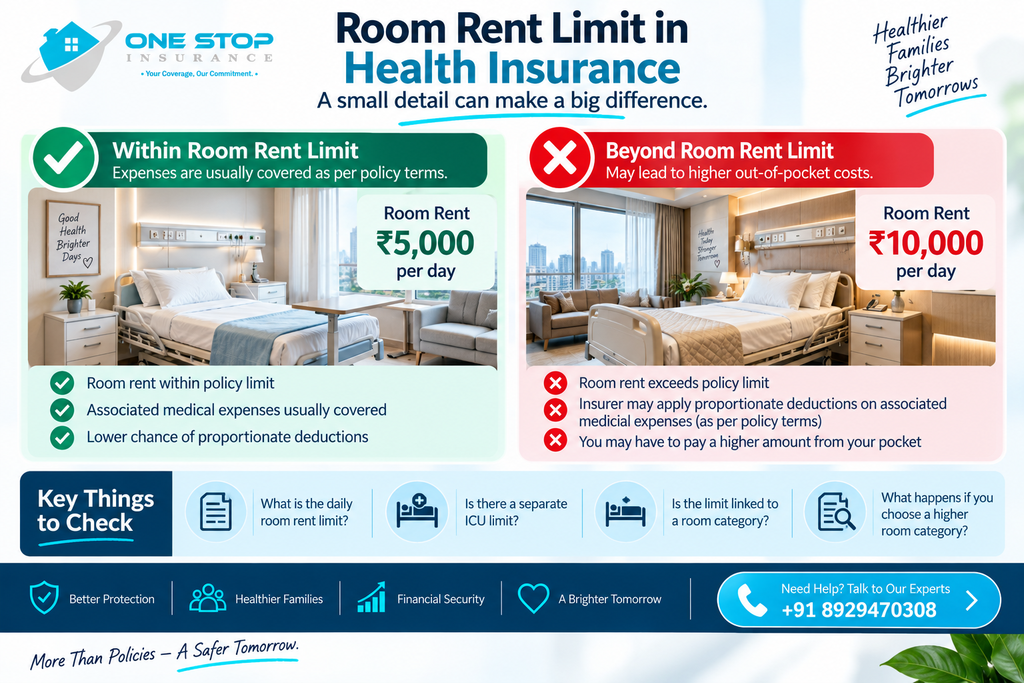
If your policy allows a certain room category or has a daily room-rent cap, choosing a more expensive room can affect your claim depending on the policy terms.
For example, imagine your policy allows a room costing up to ₹5,000 a day. During hospitalisation, you choose a room costing ₹10,000 a day.
A common assumption is:
“Fine, I will just pay the extra ₹5,000.”
That may not be how the claim works.
Some policy wordings can apply proportionate deductions to associated medical expenses when the eligible room category is exceeded. The actual calculation depends on the specific policy.
This is why room-rent conditions deserve more attention than they usually get.
Before your next health insurance renewal, check:
- Is there a room-rent limit?
- Is there a separate ICU limit?
- Is the limit linked to a particular room category?
- What happens if you choose a higher room category?
If your current policy has a strict room limit and you have never checked it properly, this is a good time to do so.
3. Co-Payment: Know How Much You May Have to Pay
Co-payment is one of those terms people often skip while reading a policy.
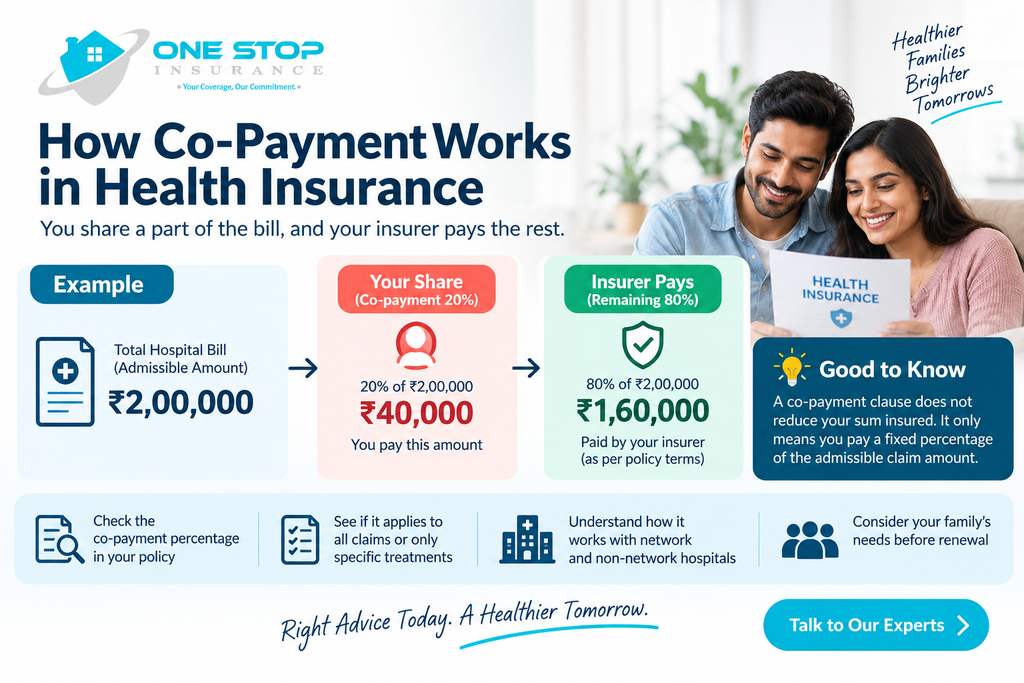
In simple words, it means you may have to pay a specified percentage of an admissible claim yourself.
Here is a simple example.
Suppose the admissible hospital bill is ₹2,00,000 and your policy has a 20% co-payment.
Your share would be:
₹40,000
The remaining ₹1,60,000 would be payable by the insurer, assuming there are no other deductions or limits.
That sounds straightforward.
But there is a bigger question:
Why does your policy have a co-payment in the first place?
Some policies may have co-pay provisions for particular conditions, age groups, treatment situations or other circumstances. The exact clause varies by product.
So don’t just look at the premium.
A plan with a slightly lower premium can look attractive until you realise that you will have to contribute a significant amount when a claim happens. When you renew, find the co-payment clause and actually read it.
4. Don’t Mix Up Co-Pay and Deductible
These two terms are often used together, but they are not the same thing.
A co-payment is generally a percentage of the admissible claim that you pay.
A deductible is a specified amount that you bear before the insurer’s liability begins, according to the policy terms.
A simple example makes it easier.
Suppose a covered medical expense is ₹1,00,000 and the applicable deductible is ₹25,000.
In a basic illustration, the first ₹25,000 would be borne by you, while the remaining eligible amount would fall within the insurer’s liability.
But don’t assume that every deductible works exactly like this.
Read the policy.
Check whether the deductible applies per claim, per person, per policy year or in some other manner.
Why does this matter?
Because people often compare policies by looking at just one thing:
“This plan costs ₹X less.”
That comparison can be misleading.
Two policies may have similar coverage but very different cost-sharing conditions.
Before renewal, understand what you would actually have to pay during a claim. That’s a much better way to compare policies.
5. Read the Parts You Usually Skip: Exclusions, Sub-Limits and Waiting Periods
Let’s be honest.
Most people don’t read the entire policy document when they buy health insurance.
That’s understandable. Policy wording is not exactly bedtime reading.
But there are a few parts you should know.
Exclusions
These are expenses, treatments or situations that the policy does not cover.
Every policy has exclusions. The list and wording can differ.
Sub-Limits
A policy may have a separate limit for a particular treatment, expense or condition, even though your overall sum insured is much higher.
For example, a ₹10 lakh policy does not necessarily mean every covered treatment is payable up to ₹10 lakh without any sub-limit.
Waiting Periods
Some conditions, including certain pre-existing diseases, may be subject to waiting periods depending on the policy and its terms.
This is particularly important when your family’s health situation has changed since the policy was first purchased.
Your health insurance renewal is a good time to go through these details again. The key point is simple:
Don’t judge a policy only by its total coverage amount.
Look at what sits underneath that number.
6. Cashless Does Not Always Mean “I Pay Nothing”
This is one of the biggest misunderstandings around health insurance.
You hear “cashless treatment” and it is easy to assume that the entire hospital bill will be taken care of.
That’s not necessarily the case.
A cashless facility is designed to let eligible treatment expenses be settled directly with the network hospital, subject to the policy terms and the applicable approval process. IRDAI’s health insurance guidance also covers important areas such as cashless treatment, room-rent limits, waiting periods, exclusions, co-payment and deductibles.
But certain amounts may still be payable by you.
That could include applicable co-payment, deductible, non-covered expenses, exclusions, room-related differences and other amounts outside the policy’s payable limits.
This issue has received renewed attention in India, with recent reporting specifically pointing out that cashless treatment does not mean zero out-of-pocket expense.
Check your hospital network before renewal
Don’t just ask whether your insurer has “thousands of network hospitals”.
Ask a more useful question:
Is the hospital I would actually use in the network?
Check the hospitals near your home.
Check the hospitals near your parents.
And if there is one particular hospital you prefer, check that one too.
You don’t want to discover a network issue while dealing with an emergency.
7. Your Insurance Should Keep Up With Your Life
This is probably the check most people overlook.
Your policy may be five years old.
Your life isn’t.
Maybe you were single when you bought it.
Now you’re married.
Maybe you had no children then.
Now you have two.
Maybe you lived in a smaller city.
Now you are in a metro.
Maybe your parents were younger.
They are not today.
Maybe you were earning ₹50,000 a month.
Your financial situation may look very different now.
All of these changes should make you stop and review your cover.
Recent analysis of the Indian health insurance market has pointed to a broader issue: some customers have insurance, but the coverage they hold may no longer fit their current needs.
That’s an important distinction.
Having insurance is not the same as having the right insurance.
Should You Increase Your Health Insurance Cover?
This is where many people get confused.
Should you simply move from ₹10 lakh to ₹20 lakh?
Should you buy a ₹50 lakh or ₹1 crore cover?
Should you add a super top-up?
There is no single answer.
A higher cover can make sense when your financial responsibilities and potential healthcare expenses have grown. In fact, demand for very high and unlimited sum-insured health plans has been rising in India, with 2026 industry data showing a sharp increase in interest in such products.
But bigger is not automatically better.
What matters is whether the overall policy is suitable.
Look at:
Coverage amount
Premium
Room-rent conditions
Co-payment
Deductible
Sub-limits
Exclusions
Waiting periods
Hospital network
Your family’s actual needs
A smaller but well-understood policy can be more useful than a huge number you never examined properly.
What About a Super Top-Up?
For some families, a super top-up can be a practical way to add more protection without replacing the entire base policy.
But again, don’t buy one simply because the coverage number looks impressive.
Understand the deductible.
Understand when the super top-up starts paying.
Understand how the policy treats claims and eligible expenses.
And check whether the structure actually works with your existing health insurance.
A top-up decision should be based on your overall coverage plan, not just the price shown on a comparison page.
A Simple Health Insurance Renewal Checklist
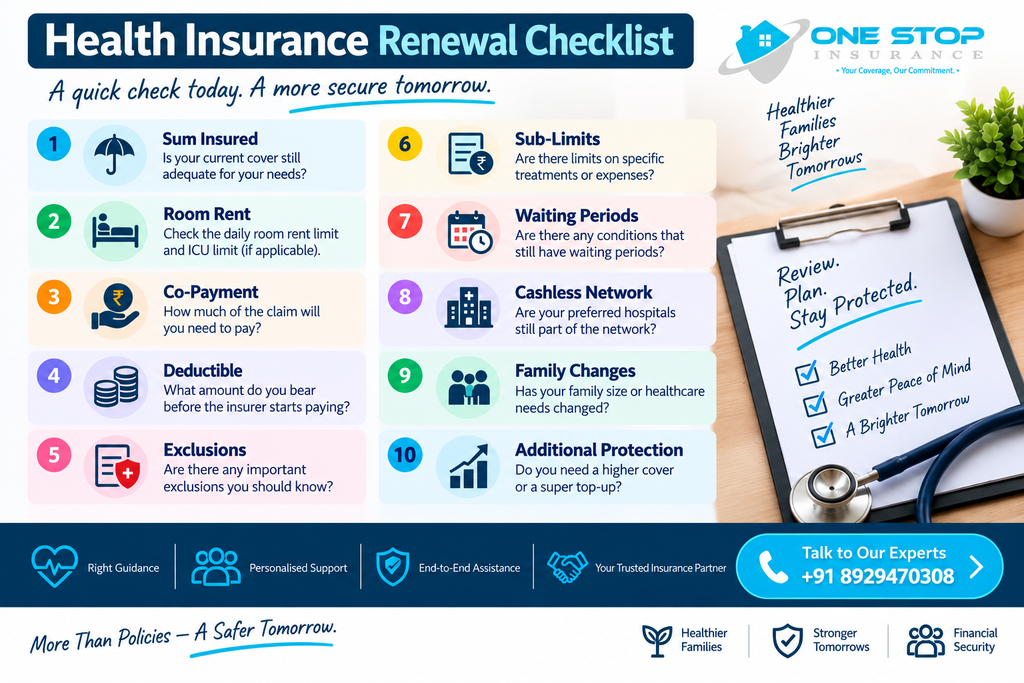
Before you renew, take ten minutes and go through this list.
1. Sum insured
Is your current cover still appropriate?
2. Room rent
Is there a daily limit or room-category restriction?
3. Co-payment
How much of an admissible claim could you have to pay?
4. Deductible
What amount do you bear before the insurer’s liability begins?
5. Exclusions
Are there any important exclusions you need to know?
6. Sub-limits
Are there limits on particular treatments or expenses?
7. Waiting periods
Are there conditions that still have waiting periods?
8. Cashless network
Are your preferred hospitals still part of the network?
9. Family changes
Has anything changed since you bought the policy?
10. Additional protection
Do you need a higher base cover or a super top-up?
You don’t need to become an insurance expert.
You just need to understand what you are paying for.
Should You Renew or Switch?
Renewing with the same insurer is not automatically the wrong choice.
Neither is switching automatically a smart one.
The right decision depends on your current policy and what you need today.
Your health insurance renewal is also a natural point to review whether switching makes sense. Before switching, compare the complete picture.
Don’t move just because another company is offering a lower premium.
At the same time, don’t stay with a policy forever just because you have been renewing it for years.
Health insurance portability can provide continuity-related benefits when an eligible policyholder moves between insurers, subject to applicable rules and conditions.
The important thing is to understand the implications before making a change.
Before your next health insurance renewal, compare the coverage you have with what you may actually need today.
Don’t Treat Renewal as a Payment Reminder
This is the easiest way to look at health insurance:
Renewal date arrives.
Premium message arrives.
You pay.
Done.
A health insurance renewal is also a good time to check whether your current cover still fits your family.
But renewal can be a useful checkpoint.
Take a look at the policy. See what has changed. Think about your family. Check whether your coverage still makes sense.
You may end up renewing the same plan.
You may increase your cover.
You may consider a super top-up.
Or you may decide that another policy is worth exploring.
There is no need to make the decision blindly.
One Final Question to Ask Yourself
A health insurance renewal should be more than an automatic premium payment.
Imagine your family needs a major hospitalisation tomorrow.
Don’t think about the policy brochure.
Think about the actual bill.
Then ask:
“Would I be comfortable relying on my current health insurance?”
If the answer is yes, great.
If the answer is “I’m not sure”, that’s exactly why a policy review is worth doing.
Health insurance works best when you understand it before you need it.
Need Help Reviewing Your Health Insurance?
At One Stop Insurance, we believe buying health insurance should not end with receiving a policy document.
The more important part is understanding whether the cover fits your needs.
Whether you already have a policy or are comparing your options, our team can help you understand the coverage, compare suitable options and guide you through the process.
One Stop Insurance
Your Coverage, Our Commitment.
Call: +91 8929470308
Frequently Asked Questions
How often should I review my health insurance?
A yearly renewal is a natural time to review your policy. You should also consider a review when your family, income, location or healthcare needs change.
Is ₹5 lakh health insurance enough?
It depends on your individual circumstances. Family size, age, location, healthcare preferences and existing coverage all matter. There is no single amount that is right for everyone.
Is ₹10 lakh health insurance enough for a family?
It may be suitable for some families and insufficient for others. The important thing is to consider both the sum insured and the conditions attached to the policy.
What is co-payment in health insurance?
Co-payment is a provision under which the policyholder bears a specified portion of an admissible claim, with the insurer covering the remaining eligible amount according to the policy terms.
What is a deductible in health insurance?
A deductible is a specified amount that the policyholder bears before the insurer’s liability begins, as defined by the policy.
Does cashless health insurance mean zero out-of-pocket expense?
No. Cashless treatment can reduce the need to pay eligible hospital expenses upfront, but co-payments, deductibles, exclusions, non-covered expenses and other policy limits may still create an out-of-pocket cost.
Should I increase my health insurance cover every year?
Not necessarily. But it is worth reviewing your coverage as your family, income, location and healthcare needs change.
Can I switch my health insurance company?
In eligible situations, portability may allow a policyholder to move to another insurer while retaining certain continuity-related benefits, subject to applicable rules and conditions.