
When people compare health insurance policies, they usually start with the same things.
How much is the cover?
How much is the premium?
How many hospitals are in the cashless network?
Fair enough.
But there are a couple of less obvious details that can change what you actually pay during a claim. Two of them are co-pay and deductible.
They sound similar, but they work differently.
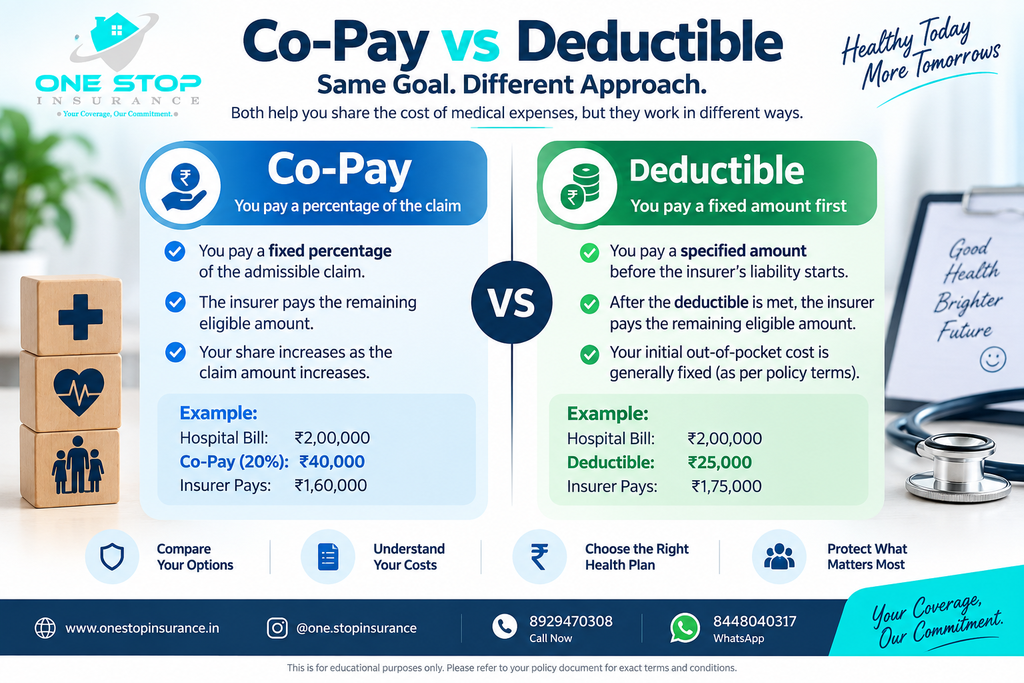
A co-pay usually means you bear a fixed percentage of an admissible claim. A deductible is a specified amount that you bear according to the policy before the insurer’s liability begins. IRDAI also describes co-payment as a cost-sharing requirement and notes that it does not reduce the sum insured.
That is why co-pay vs deductible is worth understanding before you buy or renew a health insurance policy.
You don’t need to become an insurance expert. You just need to know what these two clauses mean when a real hospital bill comes in.
Understanding co-pay vs deductible can help you read your health insurance policy more carefully.
1. What Is Co-Pay in Health Insurance?
Let’s start with the easier one.
A co-payment, commonly called co-pay, means you pay a specified percentage of an admissible claim and the insurer pays the remaining eligible amount, subject to the policy terms.
This co-pay vs deductible example makes the difference easier to understand.
For example, suppose your admissible hospital expense is:
₹2,00,000
Your policy has:
20% co-pay
Your share would be:
₹40,000
The remaining:
₹1,60,000
would be payable by the insurer, assuming the full amount is admissible and no other limits or deductions apply.
The important part is the percentage.
If the claim becomes larger, your contribution can also become larger.
That’s why a co-pay clause should never be judged only by how small the percentage looks.
A 10% co-pay may not feel like much on a small claim. On a large claim, the rupee amount can be significant.
IRDAI defines co-payment as a specified percentage of the admissible claim borne by the insured and states that co-payment does not reduce the sum insured.
2. What Is a Deductible?
A deductible works differently.
Instead of paying a percentage of the claim, you bear a specified amount before the insurer’s liability starts, according to the policy structure.
Let’s take a simple example.
Suppose your deductible is:
₹25,000
And the admissible hospital expense is:
₹1,00,000
In a basic illustration, you would bear the first ₹25,000 and the remaining eligible amount would come under the insurer’s liability.
Notice the difference?
With co-pay, the amount you pay depends on the size of the admissible claim.
With a deductible, there is a specified amount that applies according to the policy.
That is the basic idea behind the co-pay vs deductible difference.
But don’t stop at the number.
A deductible can be structured in different ways. The policy may specify how and when it applies, so check the actual wording before assuming how a claim will work.
3. Co-Pay vs Deductible: The Difference at a Glance
| Co-Pay | Deductible | |
|---|---|---|
| Main idea | You pay a percentage of the admissible claim | You bear a specified amount before insurer liability starts |
| Typical example | 20% of ₹2 lakh = ₹40,000 | ₹25,000 deductible |
| Your share | Changes with the claim amount | Depends on the deductible structure |
| What to check | Percentage and situations where it applies | Amount and how/when it applies |
| Main concern | A large claim can mean a large personal contribution | You need to have the deductible amount available |
This is the simplest way to remember the co-pay vs deductible difference:
Co-pay = percentage
Deductible = specified amount
Actual claim calculations can still be affected by other policy conditions.
4. Why Co-Pay Can Cost More on a Large Claim
This is where the percentage starts to matter.
Imagine your policy has a 20% co-pay.
Now look at three different admissible claims:
₹1,00,000 → you pay ₹20,000
₹5,00,000 → you pay ₹1,00,000
₹10,00,000 → you pay ₹2,00,000
The percentage stayed exactly the same.
Your own contribution did not.
It increased because the claim increased.
That is why someone comparing health insurance plans should ask more than:
“What is the co-pay percentage?”
Ask:
“How much could this percentage mean if I had a major hospitalisation?”
That question gives you a much clearer picture.
A 20% co-pay on a ₹50,000 claim may feel manageable.
The same 20% on a ₹10 lakh admissible claim is a very different financial situation.
This is one of the most important points to understand when comparing co-pay vs deductible.
5. Why a Deductible Feels Different
Now take a deductible of ₹25,000.
Suppose the policy applies that deductible in the way described in your policy document.
A ₹1 lakh admissible claim could leave you bearing ₹25,000 before the insurer’s liability applies.
A ₹5 lakh admissible claim would still start with that specified ₹25,000 deductible under the same structure.
The amount does not become 20% of the claim.
That’s the key distinction.
For some people, a fixed amount may feel easier to plan for. They know the initial amount they may have to arrange.
For others, even a fixed deductible may be uncomfortable, especially if they don’t keep enough money aside for unexpected medical expenses.
So when looking at co-pay vs deductible, don’t ask only which one sounds better.
Ask:
Which cost-sharing structure am I comfortable carrying?
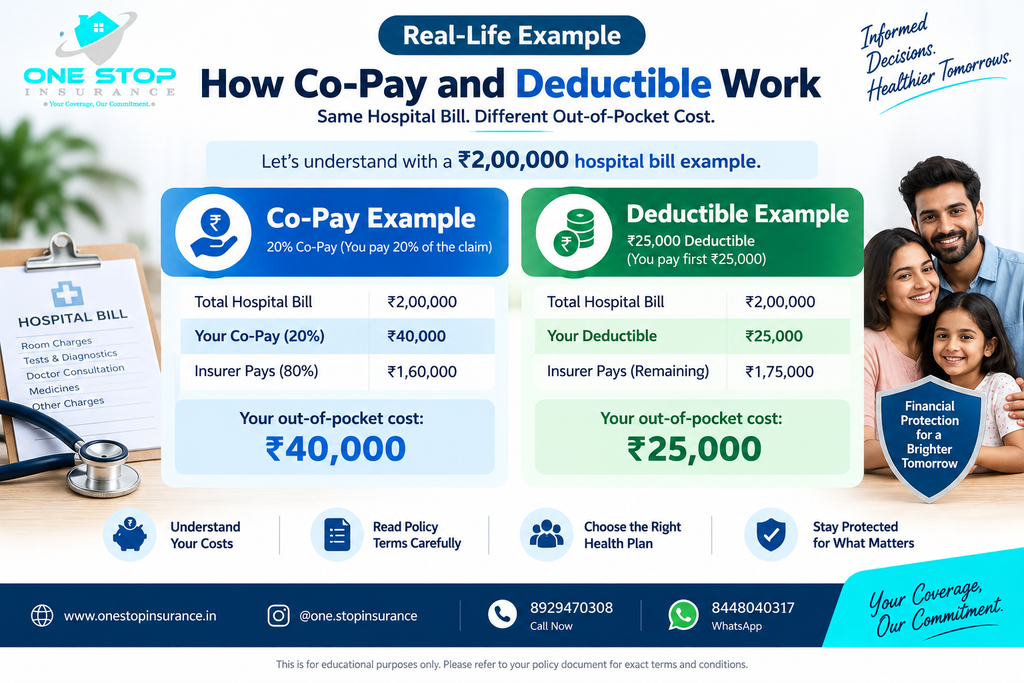
Recommended visual: A clean side-by-side graphic showing:
Co-Pay: 20% of ₹2,00,000 = ₹40,000
Deductible: ₹25,000 fixed amount
6. Can a Policy Have Both Co-Pay and Deductible?
It can, depending on the insurance product and its terms.
This is where things can get confusing.
Suppose a policy has a deductible and also has a co-payment clause for a particular situation. You should not simply assume that you can add the two numbers together and arrive at your final payment.
The way those provisions interact depends on the policy wording.
This is exactly why a real example is often more useful than a one-line explanation.
Ask the insurer or advisor:
“If my admissible claim is ₹5 lakh, how much would I actually have to pay?”
Then ask them to show the calculation.
If a policy contains more than one cost-sharing condition, understanding the order and circumstances in which each one applies becomes important.
That’s a much safer approach than making assumptions based on the premium or headline cover.
7. Don’t Confuse Co-Pay With a Room-Rent Limit
These are different things.
A co-pay tells you how much of an admissible claim you may have to share.
A room-rent limit deals with the amount or room category covered under the policy and can affect a claim depending on the policy wording.
You can have a policy with:
- Co-pay
- Deductible
- Room-rent restrictions
- Sub-limits
- Or a combination of these
That’s why looking at only one clause can give you the wrong impression of the policy.
Imagine a health insurance policy that says:
₹10 lakh cover
Sounds good.
But then you discover:
20% co-pay
Room-rent restriction
Certain sub-limits
Specific exclusions
Suddenly you know much more than you did from the ₹10 lakh figure alone.
This is the bigger lesson behind co-pay vs deductible: the headline cover is only one part of the policy.
Co-Pay vs Deductible: A Real-Life Comparison
Let’s put the two side by side with one simple example.
Situation
Admissible hospital expense:
₹3,00,000
Option A — 20% Co-Pay
20% of ₹3,00,000:
₹60,000
Your share:
₹60,000
Option B — ₹25,000 Deductible
Deductible:
₹25,000
In a basic illustration, you would bear ₹25,000 first and the remaining eligible amount would fall under the insurer’s liability.
So in this example:
Co-pay → ₹60,000
Deductible → ₹25,000
That looks like an easy comparison.
But don’t conclude from one example that a deductible is always better.
Change the claim amount, change the deductible structure, add another policy condition, and the result can look different.
The right comparison is always based on the complete policy, not a single number.
Why Do Insurers Use These Clauses?
At a basic level, both are forms of cost sharing.
The policyholder agrees to bear part of the medical expense instead of transferring the entire eligible cost to the insurer.
In some products, cost-sharing arrangements can be part of the way insurers balance premium and coverage. But a lower premium can also mean greater out-of-pocket exposure when you make a claim.
That trade-off is worth understanding before you choose a plan.
A cheap premium is useful only if the policy still fits your needs.
And a high premium is not automatically a sign that the policy is right for you.
Look at the complete picture.
What Should You Check in Your Policy?
Open your policy document and find these sections.
Co-pay:
Is there one? What percentage applies?
Deductible:
What amount applies? How does it work?
Room rent:
Is there a limit or room-category restriction?
Sub-limits:
Are certain treatments or expenses capped?
Waiting periods:
Are there conditions with waiting periods?
Exclusions:
What is specifically not covered?
Cashless network:
Are the hospitals you would actually use included?
This kind of review is also useful when you are due for renewal. You can read our health insurance renewal checklist for a broader review of your policy.
Questions You Should Ask Before Buying a Policy
Instead of asking only:
“What is the premium?”
ask:
“How much would I pay on a ₹2 lakh claim?”
“What happens if the claim is ₹10 lakh?”
“Does the co-pay apply to every claim?”
“How exactly is the deductible applied?”
“Does the deductible reset?”
“Are there other clauses that can increase my out-of-pocket cost?”
These questions help you understand the real cost of the policy.
And that’s ultimately what matters.
What About a Super Top-Up?
A super top-up can add another layer of health insurance protection, but the word deductible appears here too.
A super top-up may have a deductible before it starts responding, depending on its structure.
So if you are comparing a base policy with a super top-up, check:
The deductible
How the deductible is calculated
What expenses count toward it
When the additional cover starts responding
Don’t choose a super top-up simply because the coverage amount looks huge.
A ₹50 lakh or ₹1 crore figure can look impressive.
The more useful question is:
“How does this policy actually work when I need it?”
Recommended visual: A simple claim comparison:
₹3,00,000 admissible claim
20% Co-Pay → ₹60,000
₹25,000 Deductible → ₹25,000
Before renewing your policy, review the co-pay vs deductible terms along with your coverage and exclusions.

What Is Better for You?
There is no one answer.
A person who wants to keep a lower premium may be comfortable taking on more cost at claim time.
Someone else may prefer paying more premium upfront in exchange for less cost sharing.
Your age, family size, income, existing savings and healthcare needs all matter.
For example, someone with a healthy emergency fund may look at a deductible differently from someone who would struggle to arrange an unexpected ₹25,000 or ₹50,000.
That’s why the co-pay vs deductible decision should be personal.
Don’t copy the policy your friend bought.
Don’t choose only because the premium looks cheaper.
Understand the trade-off first.
A Quick Rule to Remember
You don’t need to memorise a complicated definition.
Just remember:
Co-pay → percentage of the admissible claim
Deductible → specified amount you bear according to the policy
Then ask one more question:
“What other conditions can affect my claim?”
That question will take you to room rent, sub-limits, exclusions, waiting periods and network hospitals.
Final Word
The co-pay vs deductible comparison becomes much easier once you stop looking at the words and start looking at actual rupees.
A percentage-based co-pay can become expensive as the claim gets larger.
A deductible gives you a specified amount to bear, but you still need to understand exactly how that deductible works.
Neither option exists in isolation.
Your health insurance policy is a package of different conditions. The sum insured is important, but so are the clauses sitting underneath it.
Before buying a policy or renewing your current one, take a few minutes to understand the cost-sharing terms.
A better understanding today can save you a lot of confusion when you actually need to use the policy.
Need Help Understanding Your Health Insurance?
At One Stop Insurance, we help customers understand their health insurance options and the terms that can affect them during a claim.
If you are comparing policies or reviewing your existing cover, we can help you understand the important details before you make a decision.
One Stop Insurance
Your Coverage, Our Commitment.
Call: +91 8929470308
Frequently Asked Questions
What is the difference between co-pay and deductible in health insurance?
The main difference is simple. A co-pay is generally a specified percentage of an admissible claim that the policyholder bears. A deductible is a specified amount that the policyholder bears before the insurer’s liability begins, according to the policy structure.
Is co-pay or deductible better?
Neither is automatically better. The right choice depends on the premium, the cost-sharing amount, how the clause applies and how much out-of-pocket expense you are comfortable carrying.
Is a 20% co-pay the same as a ₹20,000 deductible?
No. A 20% co-pay changes with the size of the admissible claim. A ₹20,000 deductible is a specified amount applied according to the policy terms.
Can a health insurance policy have both co-pay and deductible?
Yes, depending on the product. If both are present, check exactly how each clause applies instead of assuming they can simply be added together.
Does co-pay reduce the sum insured?
No. IRDAI states that co-payment does not reduce the sum insured. It changes the portion of the admissible claim that the insured bears.
Does deductible reduce the sum insured?
The deductible is a cost-sharing provision and should not be confused with a reduction in the stated sum insured. The exact way it operates should be checked in the policy wording.
Does a higher co-pay mean a lower premium?
Cost-sharing features may be used in some products as part of the premium and coverage structure, but you should compare the complete policy rather than assuming a fixed premium reduction.
What else should I check besides co-pay and deductible?
Check room-rent limits, sub-limits, exclusions, waiting periods, cashless hospitals and the overall sum insured. These clauses can also affect what you pay during a claim.
Where can I learn more about health insurance rules?
You can refer to IRDAI’s official health insurance guidance for regulatory information and consumer guidance.